By Glenn Ricketts
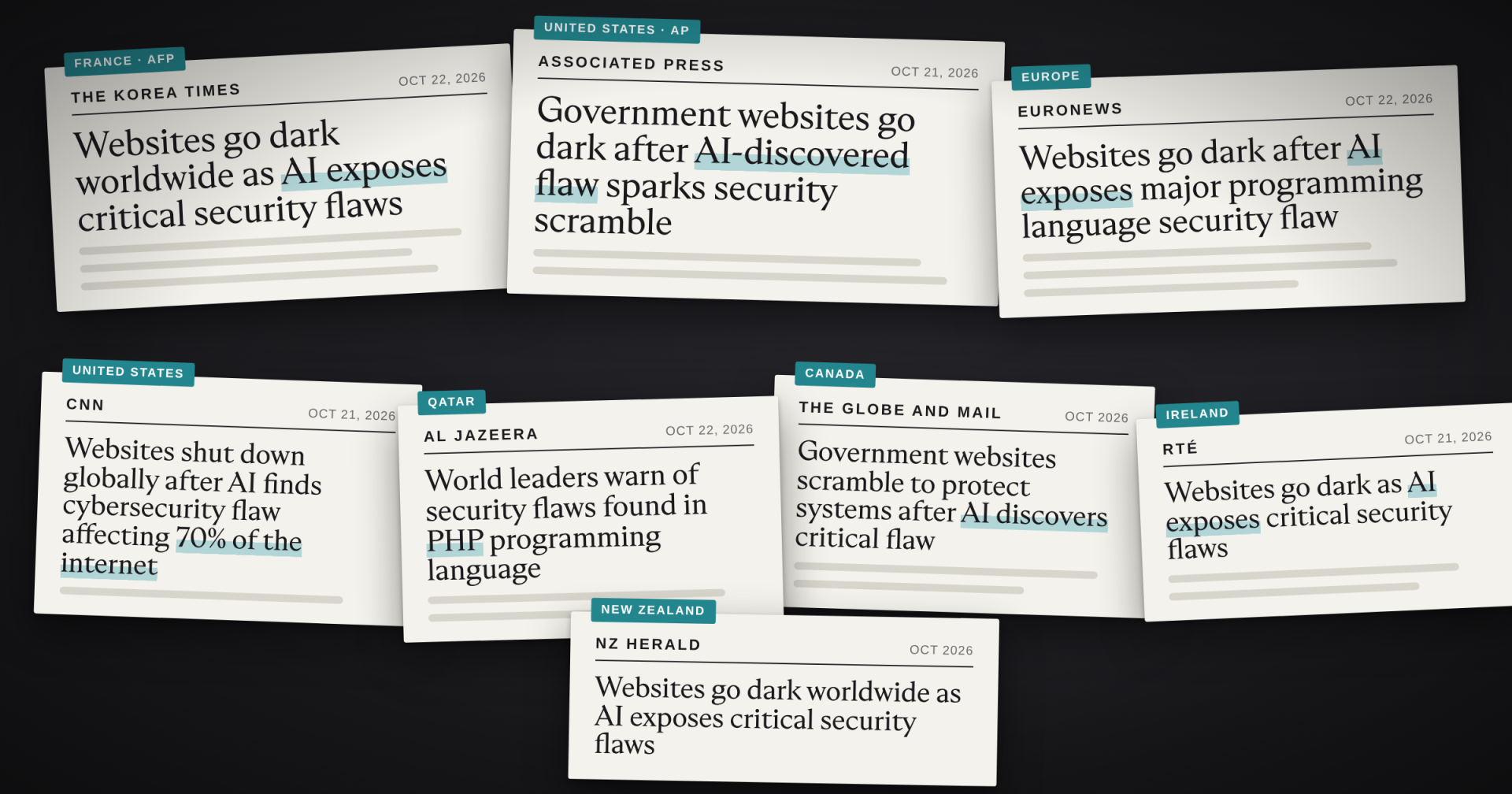
Last week, websites around the world went dark after AI uncovered critical flaws that had sat hidden in PHP for more than a decade. AI will find the next ones too. What matters now is how hard you make it for them to reach your data.
On Wednesday, the developers of PHP, the programming language behind about 70% of the world’s websites, released urgent fixes for two critical vulnerabilities. Wiz, one of the firms that found them, called them “among the most severe vulnerabilities discovered in PHP, and arguably in software history.”
Two cybersecurity firms, Calif and Wiz, found them using AI models, including OpenAI’s GPT-5.6 Sol and Google’s Gemini 4 Argon. Wiz said the flaws had stayed hidden for more than a decade.
The response was immediate and global. The US National Security Agency told organizations to patch at once or take vulnerable systems offline. Germany, France, the Netherlands, Belgium, Finland and the Czech Republic shut down government websites, and Australian government sites were hit too. The UK’s National Cyber Security Centre urged organizations to update as soon as possible. Wikipedia pulled systems down while it patched.
One researcher called it a “race to exploit.” Another put it more bluntly: “with AI exploitation may happen instantly.”
The breaches you read about are the ones that were found
This one made the news because the people who found it reported it. Even so, Amazon’s threat intelligence team saw attempts to exploit the flaws before they were made public.
The AI breaches we read about almost weekly are the public ones. If you’re a CIO, CTO or IT director, the ones that never get published are the ones you should really worry about. The AI companies aren’t in the business of advertising every hole their tools slip through.
There is no 100% safe harbor. It doesn’t exist.
In my view, agentic AI will keep looking until it finds a way through, and given enough time it will get to almost anything. The job is to make that take as long as possible.
Be the house the burglar walks past
Think about a burglar walking down a street. If your house has good locks, lights and an alarm, and the house next door doesn’t, they’ll go next door first.
That doesn’t mean they’ll never break into yours. It just makes it more difficult. With agentic AI, the aim is the same: put up as many barriers as you possibly can, so it finds someone else’s data first.
We call this data sovereignty: control over where your data lives and what can reach it. It rests on five elements:
- Network and egress isolation
- OAuth and supply chain defense
- In-house data privacy
- Audit control
Your IT team will know these well, so I won’t walk through each one. Weigh them up, whatever the technology underneath, and the gap is clear. By our assessment, a cloud-based setup delivers roughly 60% of that defense.
Private infrastructure delivers 95%.
Why the cloud is the weak link
A cloud or hosted service is a set of servers divided into virtual machines. Your service is a tenant, stacked alongside other tenants, often on the same physical disks.
There’s security between those tenancies, but they still share the same hardware.
You don’t control patching or updates. You can’t sandbox what arrives. You rely on your provider to carry out every check, every time. If an agentic AI gets in, it can bore through those layers like termites through wood, consume your data and, worse, find its way back into your core applications.
And firewalls alone won’t save you. Anyone who believes a firewall can’t be breached is fooling themselves. If an agentic AI can penetrate encrypted military assets, it can certainly get through your firewall.
Control is the best defense you have
This is why more companies are looking at private infrastructure again, whether it sits in a data center or on their own premises. They control it.
When a patch arrives, like this week’s PHP fix, you decide how it’s handled. You can load it into a sandbox, test that it’s fit for purpose and free of anything malicious, then move it into your core applications as fast as the threat demands. Is that 100%? No. But it’s a great deal better than the alternative.
So why did everyone move to the cloud in the first place? Two reasons. Predictable cost per seat per month, and no need to fund, buy and host the servers and people to run them. Ten or twelve years ago, it was a great model. Today, it carries risk. In my view, most companies trying to protect their intellectual property are walking away from it. If they aren’t yet, they should be considering it.
The alternative is subscription software that runs on your own infrastructure. You lease the software rather than buy it, but it runs in your environment. The provider has no access into your application. They can’t manage it, touch it or introduce anything to it. Patches and updates are yours to apply, when you choose.
At the end of the day, you are in control.
Where ActiveDocs stands on AI
Do we use AI at ActiveDocs? Yes. But two principles shape how.
First, we’re AI-agnostic. We’re not tied to any one model. Customers can connect Claude, Gemini, Grok, a model of their own, or none at all.
Second, AI is an assistant, not a master. AiDA, our template design assistant, helps design templates in a sandbox environment, where it makes design faster and more efficient. The templates that run in production and work with your data have no AI inference and no AI embedded in them at all. The model belongs at design time, not run time.
That doesn’t remove the risk. Nothing does. But AI never touches the templates that work with your data, and the choice of model stays with you.
The PHP fix went out on Wednesday. Whoever finds the next flaw may not report it. If you’re not sure which house you are, ask your IT team how long it would take them to test and roll out a patch like this week’s.
Sources
- Websites go dark worldwide as AI exposes critical security flaws, AFP via The Korea Times
- Government websites go dark after AI-discovered flaw sparks security scramble, Associated Press via KSL
- World leaders warn of security flaws found in PHP programming language, Al Jazeera
- Websites go dark after AI exposes major programming language security flaw, Euronews
- Websites go dark worldwide as AI exposes critical security flaws, NZ Herald