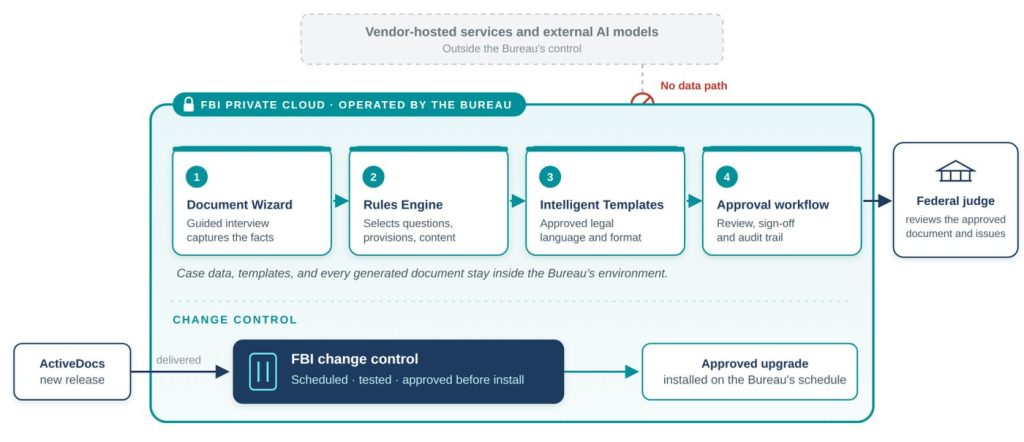
The FBI automates search warrant documents with ActiveDocs, hosted and controlled entirely by the Bureau.
The Federal Bureau of Investigation (FBI) generates search warrant documents for thousands of personnel across the United States using ActiveDocs document automation software. What sets this deployment apart is who runs it and who governs it. ActiveDocs is hosted in the FBI’s own private cloud environment and operated by the Bureau itself. It is not a vendor-hosted SaaS service, and no case information is ever placed in ActiveDocs’ hands. Just as important, no upgrade, patch, or configuration change reaches the system until it has passed through the FBI’s own change control.
For an agency whose documents contain unreleased investigative detail, those two conditions were not preferences. As artificial intelligence reshapes both the software industry and the methods of those who would attack it, they became fundamental to the safety and security of the Bureau’s work.
About the FBI
The FBI is the principal federal law enforcement agency of the United States and its domestic intelligence and security service. It leads the nation’s counterterrorism, counterintelligence, and criminal investigative efforts and holds jurisdiction over violations of more than 200 categories of federal law. Approximately 35,000 personnel serve the Bureau at its headquarters in Washington, D.C., in field offices throughout the country, and in posts abroad.
Industry
Federal law enforcement
Deployment
Self-hosted in the FBI’s own private cloud environment. Not a vendor-hosted SaaS service.
Challenge
Automate a sensitive, labor-intensive legal document without placing investigative data in a vendor’s hands or accepting software changes the Bureau had not approved.
Solution
ActiveDocs Document Wizard, Rules Engine, and Intelligent Templates, with every upgrade scheduled, tested, and approved under the FBI’s own change control.
Benefits
Investigative data stays within the FBI’s own secure environment, and no software change reaches the system without Bureau approval. Accurate, complete search warrant documents in a fraction of the time.
“A compromised update cannot silently reach the FBI’s system, because no update reaches it silently.”
The Challenge
The Fourth Amendment permits a warrant to issue only upon probable cause, and requires that it describe with particularity the place to be searched and the persons or things to be seized. Each application, with its supporting affidavit, is examined by a federal judge. To satisfy that standard, the document must set out the substance of an investigation: the identities of subjects and witnesses, the evidence gathered, the techniques used to gather it, and details of cases that have not yet been made public.
The FBI’s process for preparing these documents was well documented and dependable, but it was also labor-intensive. The Bureau wanted to automate that work. It would not do so at the expense of control over the information inside it.
The AI factor
Much of the software market now ships as vendor-hosted subscriptions, and many vendors are embedding generative AI features into their products at speed. In a hosted service, those features can arrive through an automatic update, and customer content may be sent to AI models the customer does not operate. At the same time, AI tools are helping attackers probe exposed services faster and exploit weaknesses in the software supply chain. For documents that describe active investigations, any path by which content could reach an external model, a vendor-operated service, or an unvetted software change was unacceptable.
The Solution
The FBI selected ActiveDocs because it could meet both conditions in full. ActiveDocs runs in the FBI’s own private cloud environment, administered by the Bureau. The application, its templates, and every document it generates sit within that environment. ActiveDocs does not host the system, operate it, or hold any of the data that passes through it.
At the center of the solution is a sophisticated questionnaire built in the ActiveDocs Document Wizard, encompassing a broad range of legal grounds for the issuance of a warrant. The ActiveDocs Rules Engine evaluates each answer to determine which questions follow, which legal provisions apply, and precisely what the finished document should contain. Intelligent Templates embody the approved structure and wording for each category of warrant, so legal language is drafted and sanctioned once, governed centrally, and applied consistently every time.
Upgrades on the FBI’s terms
ActiveDocs upgrades are delivered to the Bureau, not pushed into its environment. Each release is scheduled, tested, and approved through the FBI’s own change control process before it is installed.
How it Works
An authorized user opens the Document Wizard and completes a guided interview that presents only the questions relevant to the warrant at hand. Colleagues add the particulars within their purview. ActiveDocs generates the document from Intelligent Templates, it is routed through the designated approval process with every action captured in an audit trail, and the approved document is submitted to a federal judge.
Key Features
Self-hosted deployment, installed and run within the customer’s own environment, whether on-premises or in a private cloud the customer controls.
Customer-controlled upgrades, adopted only when the customer has tested and approved them through its own change control.
Deterministic document generation: approved templates and business rules determine every word, with no external AI service involved.
Document Wizard, a guided, step-by-step interface that leads users through complex legal documents.
Rules Engine governing which questions are posed, which content is included, and how each document is assembled.
Intelligent Templates with centrally administered, approved legal content.
Workflow, approvals, and audit trails, with every action recorded before any document leaves the agency.
Role-based access control administered by the agency’s own security teams.
The Benefits
Sensitive data that stays with the Bureau
Investigative information remains within the FBI’s own secure environment at every stage. No vendor hosts it, operates it, or has access to it.
Complete authority over change
Because every upgrade passes through FBI change control, the system behaves tomorrow exactly as it did today unless the Bureau decides otherwise.
Protection against emerging AI risks
Warrant content cannot be passed to an outside model, and a compromised vendor release cannot reach the system unnoticed.
Accelerated, accurate preparation
Producing a complete search warrant document now requires a fraction of the time it once did. Applications reach the bench sooner, and agents spend more of their time on the work that advances a case.
National scale, federal-grade security
Thousands of users nationwide generate search warrant documents through one system, governed by the same rules and the same approved content.
Keep your documents, and your data, under your control.
See how ActiveDocs could work for your agency.